how do you choose a secure real-time operating system for a critical system?

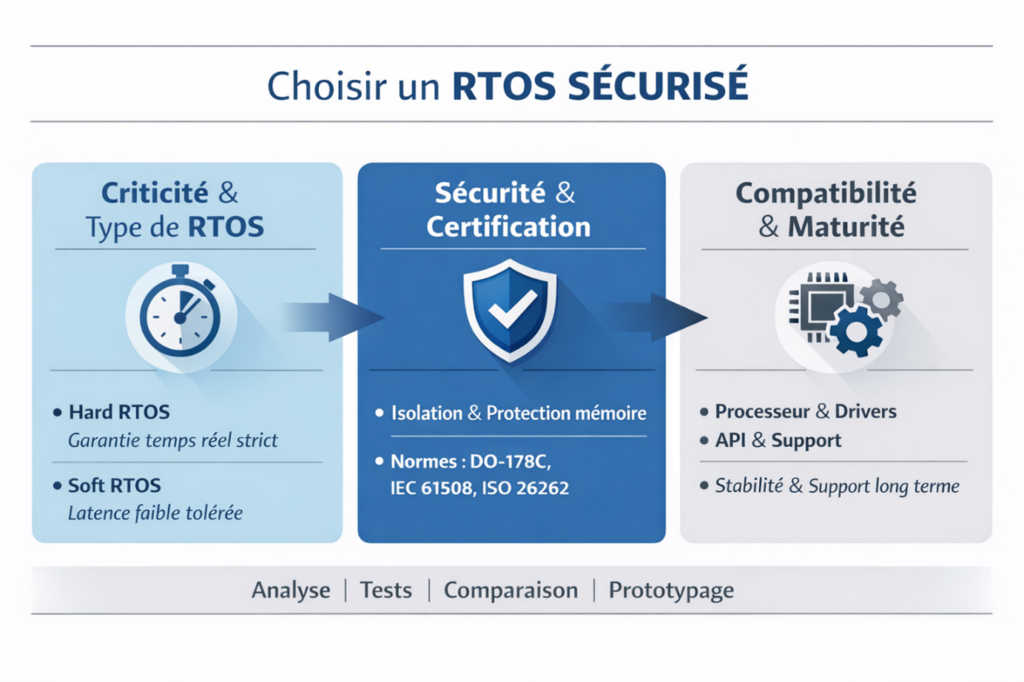
In mission-critical systems, such as those in aerospace, rail, energy, or healthcare, selecting a real-time operating system (RTOS) is no ordinary technical decision. It determines the reliability, safety, and compliance of the entire system and can directly impact deployment timelines and costs.
An RTOS enables tasks to be executed within a specific timeframe, unlike conventional systems where timing can vary.
There are two main categories: “Hard” RTOS, which guarantees a strict maximum time limit for every critical task, and “Soft” RTOS, which tolerates limited latency—suitable for less sensitive industrial applications. For instance, controlling an electric turbine requires a Hard RTOS to ensure that every operation occurs exactly within the allotted time.
Selecting a secure OS relies on several complementary criteria.
- Determinism and latency are essential: every critical task must be executable within the defined timeframe, without the risk of overrunning that limit.
- Security and task isolation protect critical functions from interference or errors originating in less sensitive modules.
- Certifications such as DO-178C (aerospace), IEC 61508 / ISO 26262 (industrial/automotive), or IEC 62304 (medical) guarantee that the OS meets rigorous safety and reliability standards.
- Certifications such as DO-178C (aerospace), IEC 61508 / ISO 26262 (industrial/automotive), or IEC 62304 (medical) guarantee that the OS meets rigorous safety and reliability standards.
Hardware and software compatibility must also be considered.
The OS must support the processors and peripherals in use, offer reliable drivers, and provide comprehensive APIs. Finally, the OS’s maturity and the quality of support ensure long-term stability and viability.
To select the right OS, a structured approach is recommended:
Analyze system criticality, define essential features, test performance on prototypes, verify security and certifications, and compare licensing, support, and costs before final implementation.
But beyond methodology, there is an additional strategic lever: leveraging expert support. Working with specialists helps secure the project from the initial stages, mitigate risks, and save time during validation and integration.
At Médiane Système, our engineers analyze specific requirements, select the most suitable OS, and optimize the security and reliability of embedded architectures.
This pragmatic, experienced approach ensures not only efficient deployment but also the longevity and robustness of critical systems.
By relying on Médiane Système’s expertise, your projects benefit from recognized technical know-how, a proven methodology, and a results-oriented approach, guaranteeing performance, security, and compliance.